

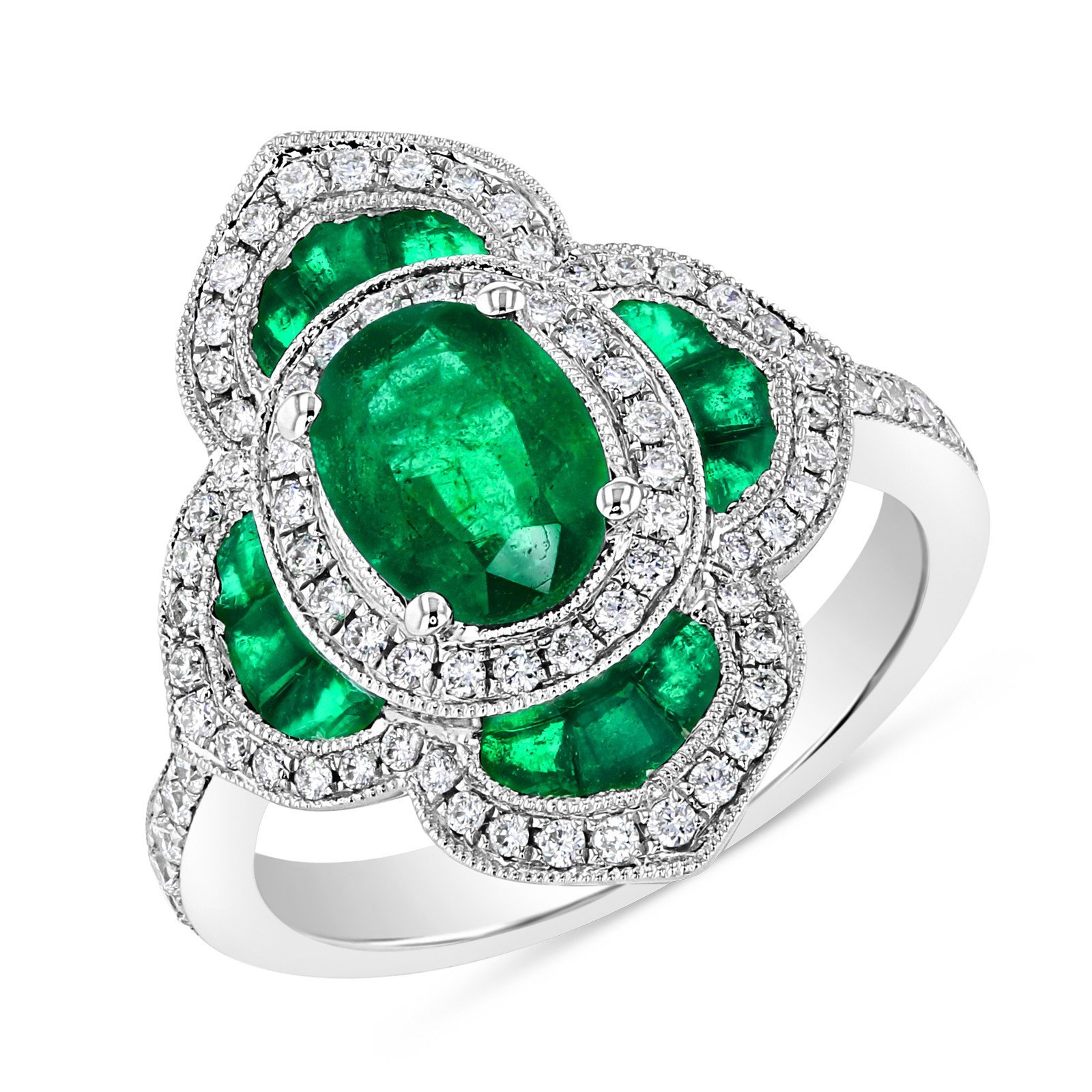
Of all the green gemstones, none captures the imagination like the emerald. Adored by pharaohs and royalty, and famously the favourite of Cleopatra, it offers a lush, living green found nowhere else in nature. Emerald is the green variety of the mineral beryl, the same family that gives us blue aquamarine and pink morganite, coloured here by traces of chromium and vanadium. Choosing a beautiful emerald is less about chasing perfection than about understanding what makes this remarkable stone what it is, and this guide walks you through colour, character, origin and care so you can choose with confidence.
In short: with emerald you are buying colour and character rather than flawlessness, so prioritise a vivid, saturated green in a medium tone, accept the inclusions known as the jardin, expect colourless oiling to be disclosed, and handle the stone gently because it is more brittle than its hardness suggests. Emerald is May's birthstone, and bought in George Town it is entirely tax-free.
Emerald at a Glance
Here are the facts clients ask for most often, gathered in one place and expanded in the sections that follow. You can see fine emeralds in context across our coloured gemstone collection.
| Property | Emerald |
|---|---|
| Mineral | Beryl (beryllium aluminium silicate) |
| Colour range | Bluish green to slightly yellowish green |
| Mohs hardness | 7.5 to 8, but brittle due to inclusions |
| Notable sources | Colombia, Zambia, Brazil, Afghanistan |
| Birthstone | May |
| Anniversary | Twentieth and fifty-fifth wedding anniversaries |
| Common treatment | Oiling with colourless oil, to improve clarity |
| Care | Warm soapy water and a soft brush; never ultrasonic or steam |
Colour: The Defining Quality
Colour is the heart of an emerald and the single biggest driver of value. A stone with truly fine colour forgives a great deal elsewhere, while a pale or grey stone disappoints however clean it may be.
Hue, tone and saturation
The ideal is a vivid, saturated green, sometimes leaning gently toward blue, in a medium to medium-dark tone that stays bright rather than dark or grey. Too light and the stone reads as ordinary green beryl rather than emerald; too dark and it loses its glow under anything but strong light. The most prized stones hold their rich green even in soft, indoor lighting.
Why saturation rules
Saturation is what separates a merely pleasant stone from a breathtaking one. It is the purity and intensity of the green, free of distracting grey or brown, and it is the quality a trained eye notices first. When you compare emeralds side by side, the more saturated stone almost always looks the more expensive, even at a smaller size.
Origin: Colombia, Zambia and Beyond
Origin often shapes colour, so it is useful context, but let your eye lead and treat the source as a clue rather than a guarantee of beauty.
Colombian emeralds
Colombia, especially the historic Muzo and Chivor mines, is famous for a warm, pure green widely held as the benchmark for the species. A documented Colombian origin of fine colour carries the strongest reputation and the highest premiums.
Zambian and Brazilian emeralds
Zambia produces emeralds with a slightly cooler, bluish-green tone and often very good clarity, while Brazil and Afghanistan also yield fine material. A superb Zambian stone can easily outshine a tired Colombian one, so judge the stone in front of you. Our guide to coloured gemstone jewellery in Cayman explains how we weigh origin against the qualities you can actually see.
The Jardin: Why Inclusions Are Expected
A natural fingerprint
Almost every natural emerald contains inclusions, and rather than being seen as flaws they are embraced as part of the stone's identity. The trade calls this internal world the jardin, French for garden, because the fine fissures and crystals can look like foliage suspended in green. These features prove a stone is natural and give each emerald a fingerprint all its own.
How clean is clean enough
A completely eye-clean emerald is rare and highly prized, but demanding flawlessness here is unrealistic and unnecessary. The aim is a stone whose inclusions do not dull its colour or threaten its durability. Surface-reaching fissures near a corner or girdle matter most, because they affect both appearance and strength, so they deserve a closer look than tidy internal features deep within the stone.
The Emerald Cut, Oiling and Treatment
The emerald cut
The classic emerald cut, a rectangular step cut with trimmed corners, was developed for this very gem. It shows the colour to full effect and, just as importantly, protects the more vulnerable corners from chipping. The same elegant outline is now a favourite for diamonds too, as our diamond shapes guide describes.
Oiling, the accepted treatment
Oiling is the standard, long-accepted treatment for emerald. Colourless oil, traditionally cedarwood, fills surface-reaching fissures to improve clarity, and a reputable jeweller will always disclose it; the oil can be gently refreshed over the years. What you should avoid are stones heavily dyed or filled with coloured resin, which masks poor colour and can fail over time. Always ask for written disclosure of any treatment.
| Beryl variety | Colour | Typical clarity |
|---|---|---|
| Emerald | Vivid green (chromium and vanadium) | Usually included; the jardin is expected |
| Aquamarine | Sky to sea blue (iron) | Typically eye-clean |
| Morganite | Soft pink to peach (manganese) | Typically eye-clean |
Durability, Birthstone and Care
Handle with care
Emerald rates roughly 7.5 to 8 on the Mohs scale, which sounds hard-wearing, but its many inclusions and fissures make it more brittle than that number suggests, so it needs gentler handling than ruby or sapphire. It is best enjoyed in pendants, earrings and dress rings, and in everyday rings set protectively, removed before sport or rough work. A bezel or a halo of diamonds adds welcome security around the stone.
The May birthstone
Emerald is the birthstone for May and the gem of the twentieth and fifty-fifth wedding anniversaries, symbolising renewal, hope and new beginnings, which makes it a popular choice for spring birthdays and milestones. See where it sits among the other birthstones by month, and find ideas in our anniversary jewellery gift guide.
Cleaning safely
Never use an ultrasonic or steam cleaner on an emerald, because both can damage the stone and strip its oiling. Clean it gently with warm, soapy water and a soft brush, then pat it dry, and remove it before sport or rough work. Our guide to cleaning and caring for fine jewellery sets out a safe routine in full.
With emerald, you are not buying flawless perfection; you are buying the most beautiful, lively green your eye can find, with a private garden of inclusions to prove it is real.
Buying an Emerald Tax-Free in Grand Cayman
Chosen well, an emerald is one of the most romantic gemstones you can own, and a vivid green stone makes an unforgettable centre for coloured-stone engagement rings. Every emerald we present in George Town comes with independent certification and clear disclosure of any treatment, and you are welcome to compare several stones in the hand with our fine jewellery team.
Walk in whenever it suits you, with no appointment needed. Every purchase is tax-free, with no sales tax and no VAT, so an emerald here can cost roughly 20 to 35 percent less than the same stone in the United States, the United Kingdom or Europe, and we offer free insured worldwide shipping. See how tax-free shopping works, or visit us on the George Town waterfront.