
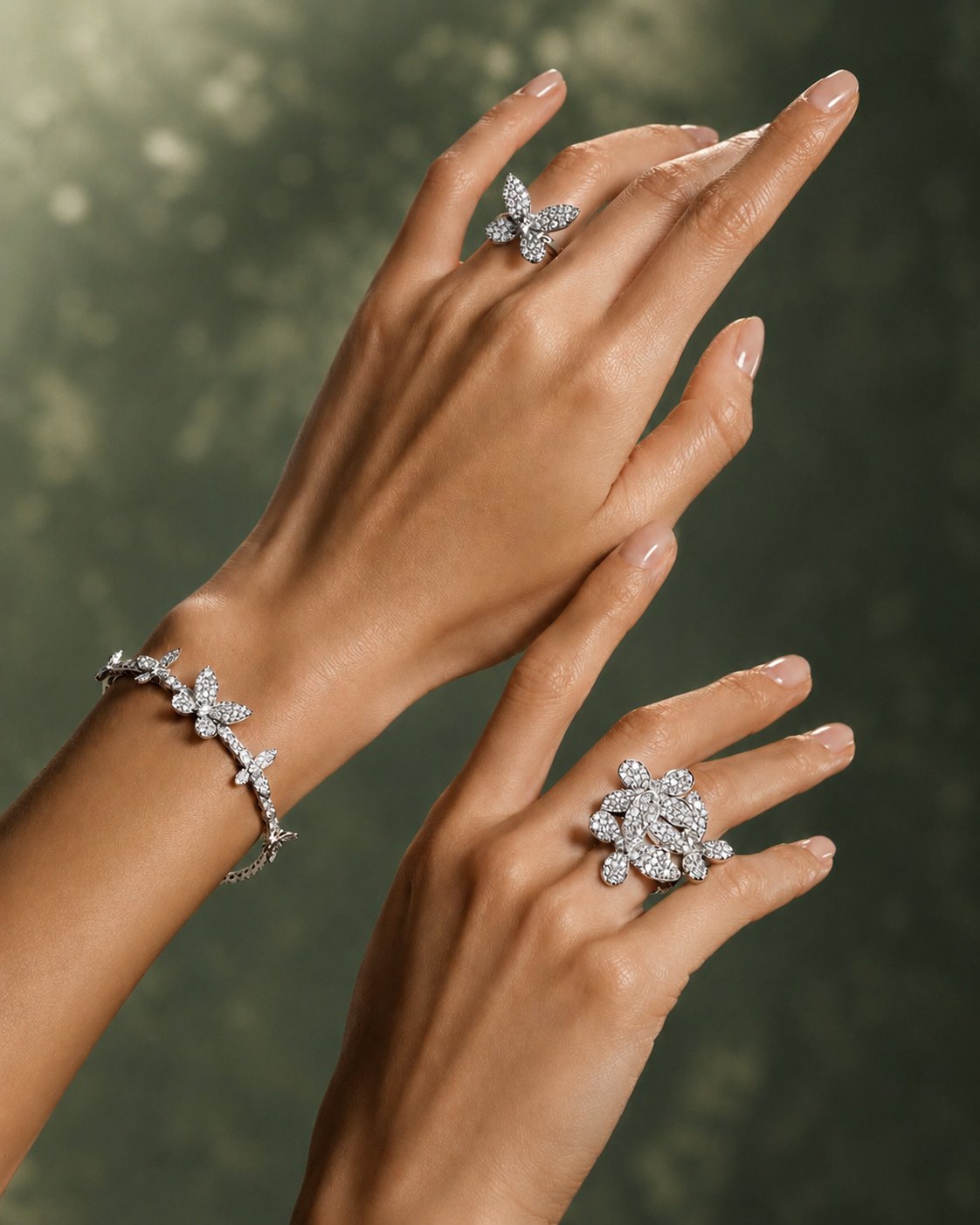
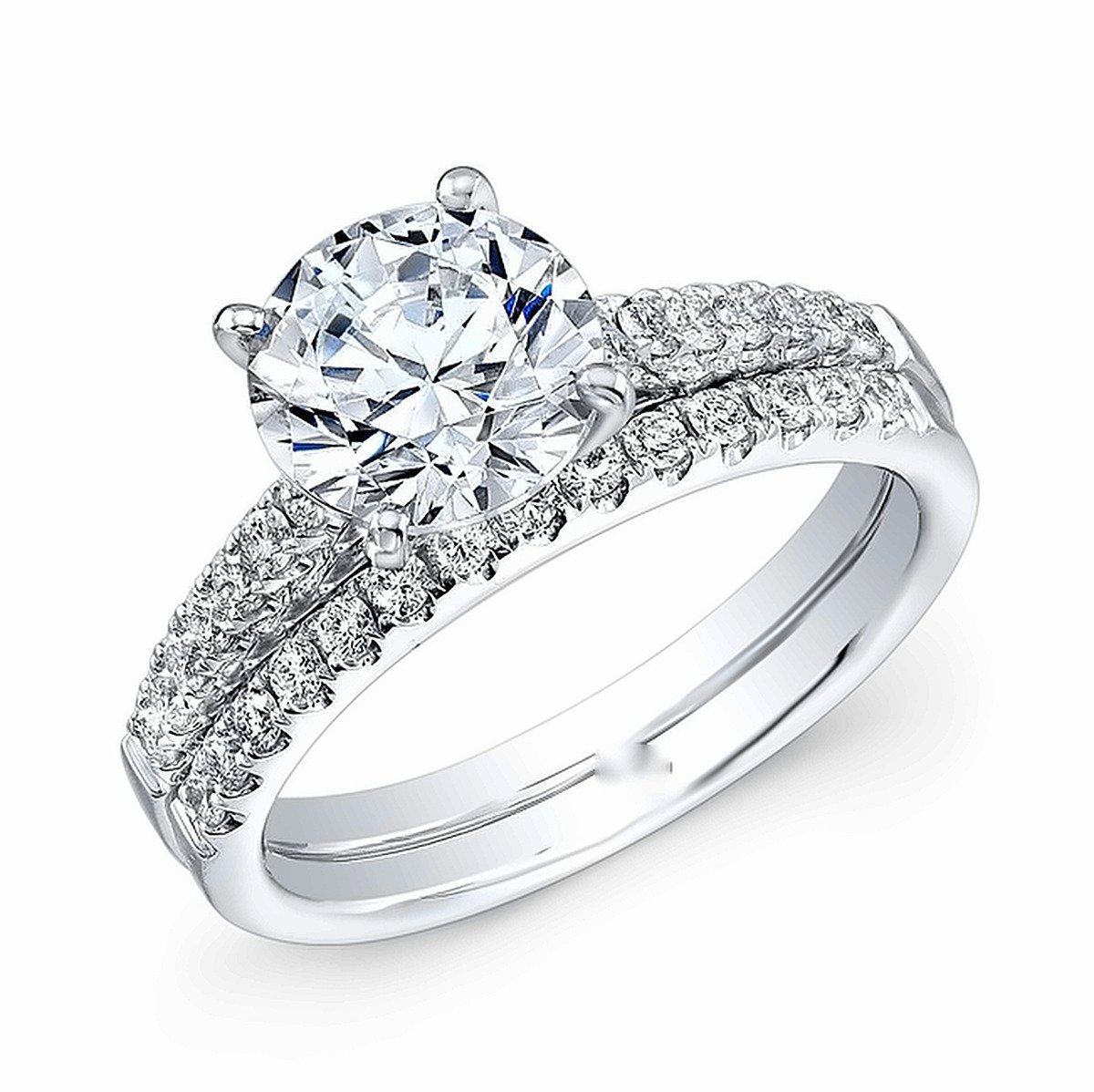
Your engagement ring has lived on your hand for months; now the wedding band has to join it for life. The two rings will sit together every single day, so the goal is a pairing that looks deliberate rather than accidental. A few choices, the metal, the shape, the finish and the proportion, decide whether the band frames the centre stone beautifully or quietly fights it. None of them is difficult once you know what to look for.
In short: match the metal and finish first, shape the band to clear or hug your setting, keep the widths in proportion, and decide on plain, pave or eternity to suit your taste. A high-set solitaire takes a straight band, while a halo or low cluster usually needs a contoured or curved one. The cleanest match of all is a bridal set designed as a pair.
Match the Metal and Finish First
The simplest way to make two rings read as one set is to start with the metal, because colour and the way a metal ages are the first things the eye notices.
Keeping the metal consistent
A white-gold solitaire pairs most naturally with a white-gold band, and a yellow-gold ring with a yellow-gold band, because the colours and the way they wear stay in step over the years. Finish matters too: a high-polish band against a high-polish ring feels seamless, while a brushed or matte band introduces a contrast you should choose on purpose. Our precious metals guide explains how each metal looks and ages.
Mixing metals on purpose
Mixing metals can look deliberate and modern, yet it works best when there is a shared cue, such as a rose gold band beneath a ring that already carries a rose gold gallery, or a two-tone engagement ring that invites either colour. The difference between intentional and accidental is whether the second metal echoes something already in the first ring.
Shape the Band to Your Ring
The setting of your engagement ring decides how a band can sit against it. The aim is for the two rings to meet without an awkward gap and without the band knocking the centre stone.
Flush, contoured and curved
A flush, or straight, band suits high-set solitaires, where the band slides up to the shank without touching the diamond. A contoured band has a gentle notch cut to clear a low-set stone, a basket of prongs, or the gallery of a halo. A curved, chevron or shadow band sweeps around the centre stone or hugs a halo's outer edge, hiding any gap and reading as one continuous design. If you are still choosing a setting, our halo versus solitaire guide and three-stone rings guide show how each affects the band you will need.
| Band shape | Suits which ring | How it sits |
|---|---|---|
| Flush (straight) | High-set solitaires | Slides up to the shank, clear of the stone |
| Contoured | Low-set stones, halos, prong baskets | A notch clears the setting to sit closer |
| Curved (chevron) | Halos and low clusters | Sweeps around the stone as one design |
Plain, Pave or Eternity
Beyond the shape, how much sparkle the band carries changes the whole look of the pair.
- A plain metal band is timeless and hard-wearing, lets the engagement ring stay the centre of attention, and is the easiest to resize and engrave. Our classic wedding bands guide covers the options.
- A pave or micro-pave band adds a discreet line of sparkle that echoes a diamond-set engagement ring without competing with it.
- A half or full eternity band brings the most brilliance, but full eternity rings cannot be resized and the underside stones can feel firmer against the finger; our diamond eternity bands guide explains the trade-offs.
Profile, Stacking and Soldering
The last decisions are about how the two rings live together day to day.
Keeping proportion
Keep the band's width and rise in proportion with the engagement ring's shank. A delicate solitaire can be overwhelmed by a heavy band, and a substantial ring looks unbalanced above a wisp of metal. Matching the band roughly to the width of the engagement ring's shank is a reliable starting point, and getting both sized accurately matters, so use our ring size guide.
Stacking or soldering
If a small gap between the rings bothers you, the two can be soldered into a single unit, which stops them spinning, keeps the diamonds aligned and reduces the wear that happens where rings rub. Soldering is permanent and makes future resizing more involved, so wear the rings together for a while first to be certain of your fit. If you prefer to keep them separate, a contoured or curved band closes most of the gap on its own.
Which ring sits where
By tradition the wedding band is worn closest to the heart, below the engagement ring, so it goes on first at the ceremony, though many people simply wear the order they find most comfortable. If the two rings rub or spin, a contoured band or a discreet pair of sizing beads keeps them aligned without soldering. A ring jacket or wrap is another option that cradles the engagement ring without altering it permanently. Whatever you choose, wearing both together for a few weeks before any permanent step is the surest way to know the pairing is right.
The Easiest Match: A Bridal Set
The surest route to a flawless match is to buy both rings together as a bridal set, designed, sized and finished as a pair from the very start. A set removes all the guesswork, because the band is shaped to the ring before either is made, and the metals and finishes are chosen together. If a partner's band is part of the picture, our men's wedding bands guide covers wider proportions, and the whole family of rings can be planned at once.
The two rings should read as one design, deliberate in metal, shape and proportion, never accidental.
Design Your Pair in George Town
At IDC Cayman on the George Town waterfront in Grand Cayman, you can hold wedding bands directly against your engagement ring and design the two as a matched bridal set in our workshop, with no appointment needed. Every band is crafted in 14-carat or 18-carat gold around GIA-certified diamonds, sold entirely tax-free with no sales tax and no VAT, roughly 20 to 35 percent less than abroad, and backed by lifetime after-care. Visit us in George Town, or say hello first.