Few gems divide a room quite like opal. Where a diamond returns clean white light, a fine opal seems to hold a living fire inside it, flashes of green, blue, orange and red that shift and dance as the stone moves. Opal is not a crystal at all but hydrated silica, made of countless tiny silica spheres laid down with water over millions of years, and it can hold between three and twenty percent water by weight. That unusual structure is the source of both its magic and its fragility, and understanding it is the first step to buying well.
In short: choose opal by the brightness, colour range and pattern of its play-of-colour, prefer a solid natural stone over an assembled doublet or triplet, and remember it is softer and more delicate than most gems at about 5.5 to 6.5 on the Mohs scale. Set it protectively, treat it as a special-occasion piece, and bought in George Town it is entirely tax-free.
A Gem Made of Light and Water
Opal behaves unlike any other gem because it is built differently. Knowing how it is made explains both why it dazzles and why it asks for gentler care than a ruby or a sapphire. It is one of the more unusual members of the wider coloured gemstone family, and a stone we always discuss honestly before a sale.
Why opal is not a crystal
Instead of a regular crystal lattice, opal is an orderly stack of microscopic silica spheres with water trapped between them. When those spheres are uniform and well arranged, they split passing light into spectral colours, which is the play-of-colour you see. Because water is part of the structure, opal can dry out and craze if it is mistreated, a risk no faceted crystal faces.
Why body tone matters
Body tone, meaning the darkness or lightness of the background, has an enormous effect on how vividly the colour reads. Flashes of fire stand out far more dramatically against a dark base than against a pale one, which is why a dark-bodied black opal can look so much more dramatic than a pale one of similar colour. Body tone is the first thing to assess after the colour itself.
The Main Types of Opal
Opal is best understood as a family, and the type sets the stage for everything else, from how the colour reads to how the stone should be worn.
Black, white and crystal opal
- Black opal, the most prized and valuable, with a dark grey to jet body tone that makes its play-of-colour blaze. The finest examples come from Lightning Ridge in Australia.
- White or light opal, with a pale milky body. It is the most widely seen opal; the play-of-colour is softer because the background is light, which also makes it more affordable and very wearable.
- Crystal opal, transparent to semi-transparent with a clear body, prized when its play-of-colour glows with depth and clarity right through the stone.
Boulder and fire opal
- Boulder opal, in which a thin seam of colour remains attached to its host ironstone. The dark natural backing gives boulder opal a rich, dramatic look, and every stone is shaped by its own seam.
- Fire opal, a different proposition entirely: a transparent to translucent stone in warm yellow, orange or red body colour, usually from Mexico, often faceted and frequently showing little or no play-of-colour, valued instead for its glowing body hue.
| Type | Body tone | What to know |
|---|---|---|
| Black opal | Dark grey to jet | Most valuable; colour blazes against the dark base |
| White opal | Pale, milky | Most common; softer colour, very wearable |
| Crystal opal | Transparent to clear | Play-of-colour glows right through the stone |
| Boulder opal | Dark ironstone backing | Natural backing, one-of-a-kind shapes |
| Fire opal | Yellow, orange, red | Often faceted; valued for body colour, not always play |
Play of Colour: Where the Value Lives
Play-of-colour is the single most important value factor in precious opal, and three qualities define it.
Brightness, range and pattern
Brightness, the intensity of the flashes, matters most: a brilliant opal is worth far more than a dull one of the same pattern. Range comes next, with stones that show the full spectrum, especially strong reds, prized above those that flash only blue and green, since red is the rarest direction. Finally pattern describes how the colour is arranged; broad, bold mosaics such as harlequin and broad flash are rare and coveted, while fine pinfire is pretty but more common.
How to read an opal
Read an opal by tilting it in several directions and under different light, because a stone can be brilliant from one angle and quiet from another, and you want colour that travels well across the whole face. A dead spot, an area with no play-of-colour, lowers value, so look at the stone the way you will actually wear it before deciding. This face-up, in-the-hand assessment is at the heart of how we choose every piece of fine jewellery.
An opal is bought with the eye in motion; tilt it, turn it, and let the fire prove itself from every angle.
Origins, Solids and Assembled Opals
Two practical questions follow once you love a stone: where it came from, and whether it is a single natural opal or an assembled one.
Australia and Ethiopia
Australia has long been the heartland of fine opal and still produces the celebrated black, boulder and white material; Lightning Ridge, Coober Pedy and Quilpie are names worth knowing. Ethiopia emerged more recently as a major source, and its Welo opal can be spectacular, often with vivid colour, though much of it is hydrophane, meaning it can absorb water and temporarily change appearance, so it needs extra care.
Solids versus doublets and triplets
A solid opal is a single natural stone and is what you want for a serious purchase. A doublet bonds a thin slice of opal to a dark backing, and a triplet adds a clear protective cap on top; both make thin colour usable and more affordable, but they are worth considerably less than solids and the layers can be harmed by water over time. We always tell you which you are looking at, in keeping with the disclosure principles in our coloured gemstone jewellery guide.
| Construction | What it is | Relative value |
|---|---|---|
| Solid | One natural opal throughout | Highest; the choice for a serious piece |
| Doublet | Thin opal bonded to a dark backing | Lower; water can damage the bond |
| Triplet | Doublet with a clear protective cap | Lowest; most affordable, least durable |
Opal at a Glance
These are the key facts our gemologists return to most often when guiding a client through an opal purchase.
| Property | Detail |
|---|---|
| Composition | Hydrated silica, three to twenty percent water |
| Mohs hardness | 5.5 to 6.5 |
| Top value factor | Bright, wide-range, boldly patterned play-of-colour |
| Birthstone | October, shared with tourmaline |
| Anniversary | Traditional gift for the fourteenth |
| Main sources | Australia and Ethiopia, with Mexican fire opal |
| Care | Gentle; no heat, ultrasonic, steam or harsh chemicals |
Durability, Care and Settings
Opal rewards a little understanding. Treat it as the special, delicate stone it is and it will last beautifully for generations.
Handling a water-rich gem
Opal sits at roughly 5.5 to 6.5 on the Mohs scale, softer than quartz, and because of its water content it can craze, meaning develop fine surface cracks, if it is dried out or shocked by sudden temperature change. Treat opal as a special-occasion stone rather than an everyday knockabout, and keep it away from heat and very dry environments.
Cleaning and storage
Never put opal in an ultrasonic or steam cleaner, and keep it away from harsh chemicals. Clean it only with a soft damp cloth, and store it apart from harder gems that could scratch it. Our jewellery care guide sets out safe routines, and our in-house services include gentle professional cleaning and setting checks.
Protective settings
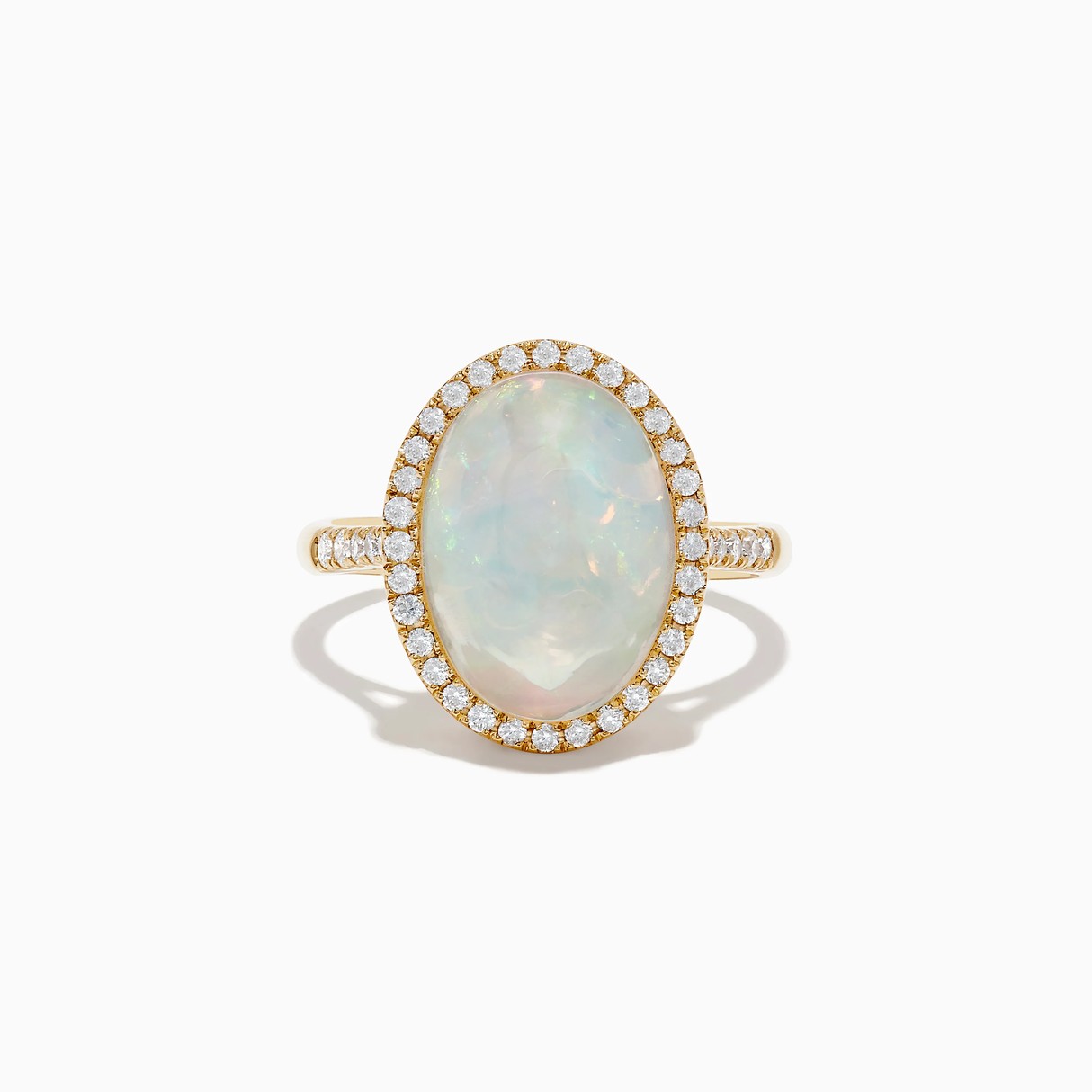
In jewellery, protective settings earn their keep: bezels that surround the girdle, halos, and pendants or earrings that take less abuse than a ring all suit opal beautifully and let the play-of-colour take centre stage. White or yellow metals both work, depending on the body tone, and our precious metals guide helps you choose. As an October stone, opal also makes a memorable anniversary gift; match any month to its stone in our birthstones by month guide.
Buying Opal Tax-Free in George Town
Every opal at IDC Cayman is chosen by eye for the brightness and travel of its colour, set to protect a stone we are honest about caring for, and sold completely tax-free, with no sales tax and no VAT, so a piece here can cost roughly 20 to 35 percent less than the same stone elsewhere. Browse our coloured gemstones and the wider shop, then visit us on the George Town waterfront with no appointment needed; ask about free insured shipping worldwide or get in touch before you travel.