Few gemstones command attention like a fine ruby. The deep, glowing red of a top-quality ruby has been prized across cultures for thousands of years, worn by royalty as a symbol of passion, protection and enduring love. If you are considering ruby jewellery, whether a statement ring, a pair of earrings or a piece to mark a milestone, understanding what separates an ordinary red stone from a truly fine ruby will help you buy with confidence. This guide is written for buyers in the Cayman Islands, where you can acquire fine ruby jewellery genuinely tax-free in the heart of George Town.
In short: the value of ruby jewellery rests on colour above all, the coveted pigeon-blood red, followed by origin, clarity, cut and carat weight. Buy from a jeweller who discloses every treatment and provides independent certification for important stones. In the Cayman Islands you can do exactly that, tax-free, with the help of our coloured gemstones specialists, and for a deeper look at grading you can also read our ruby buying guide.
What makes a fine ruby
Ruby is the red variety of corundum, the same mineral species as sapphire, and it owes its colour to traces of chromium. At 9 on the Mohs scale of hardness it is second only to diamond, which makes it superbly durable for rings and everyday wear. Five factors decide how fine a given ruby really is.
Colour: the pigeon-blood standard
Colour is by far the most important factor in a ruby's value. The finest rubies show a pure, vivid red with the faintest blue undertone, a hue the trade calls pigeon-blood red. It is neither too dark nor too pink, with medium to medium-dark tone and strong saturation. Because chromium also causes fluorescence, the best stones seem to glow from within, especially in daylight. Rubies that drift towards orange, brown or purple, or that look pale, are priced well below this ideal.
Origin: Burmese and beyond
Origin can influence both beauty and value. Historically the most celebrated rubies come from the Mogok region of Burma (Myanmar), famous for an intense red and gentle fluorescence. Mozambique now supplies much of the fine market and can rival Burmese material, while Thailand, Madagascar, Sri Lanka and Tanzania are other notable sources. An unheated Burmese ruby with a respected laboratory report commands a premium, yet a beautiful stone from another origin can offer excellent value, so always judge the gem in front of you first.
Clarity: the nature of the stone
Rubies almost always contain inclusions, and their presence is expected rather than a flaw. Fine silk, the needle-like rutile inclusions found inside many rubies, can soften light and may even indicate that a stone has never been heated. What matters is whether inclusions affect brilliance or durability. A lively stone with minor inclusions is usually preferable to a cleaner one of duller colour.
Cut: bringing colour to life
A well-judged cut balances colour, brilliance and weight. Because fine rough is scarce and colour is paramount, cutters often orient a ruby to maximise its red, so you will see more variety in ruby cutting than in diamond. Look for even colour across the face, pleasing symmetry and no obvious windowing, the pale see-through zone that appears when a stone is cut too shallow.
Carat: size and rarity
Fine rubies above one carat are genuinely scarce, and the price per carat climbs steeply with size when colour and clarity are strong. A one-carat ruby of top colour can cost far more than a diamond of the same weight. For everyday jewellery, a smaller ruby of excellent colour will often outshine a larger, duller one.
Natural, lab-grown and treated rubies
Not every red stone is the same, and knowing the categories is essential before you buy.
- Natural rubies formed in the earth over millions of years; the most valued and collectible.
- Heat-treated rubies, natural stones warmed to improve colour and clarity; this is stable, permanent and widely accepted when disclosed.
- Glass-filled composite rubies, low-grade material whose fractures are filled with lead glass; inexpensive but fragile and unsuitable for fine jewellery.
- Lab-grown rubies, chemically identical to natural ruby but created in a laboratory; attractive and affordable, though without the rarity of a natural stone.
A reputable jeweller will always tell you exactly what you are buying. Ask directly whether a ruby is natural or lab-grown, and what treatments it has undergone, then request the answer in writing.
Treatment and origin should be disclosed clearly and, for significant stones, supported by an independent report. If you would like to compare rubies with their blue cousins in the same corundum family, our sapphire buying guide is a useful companion.
Types of ruby jewellery
Ruby suits almost every kind of piece, from bold statements to quiet everyday wear.
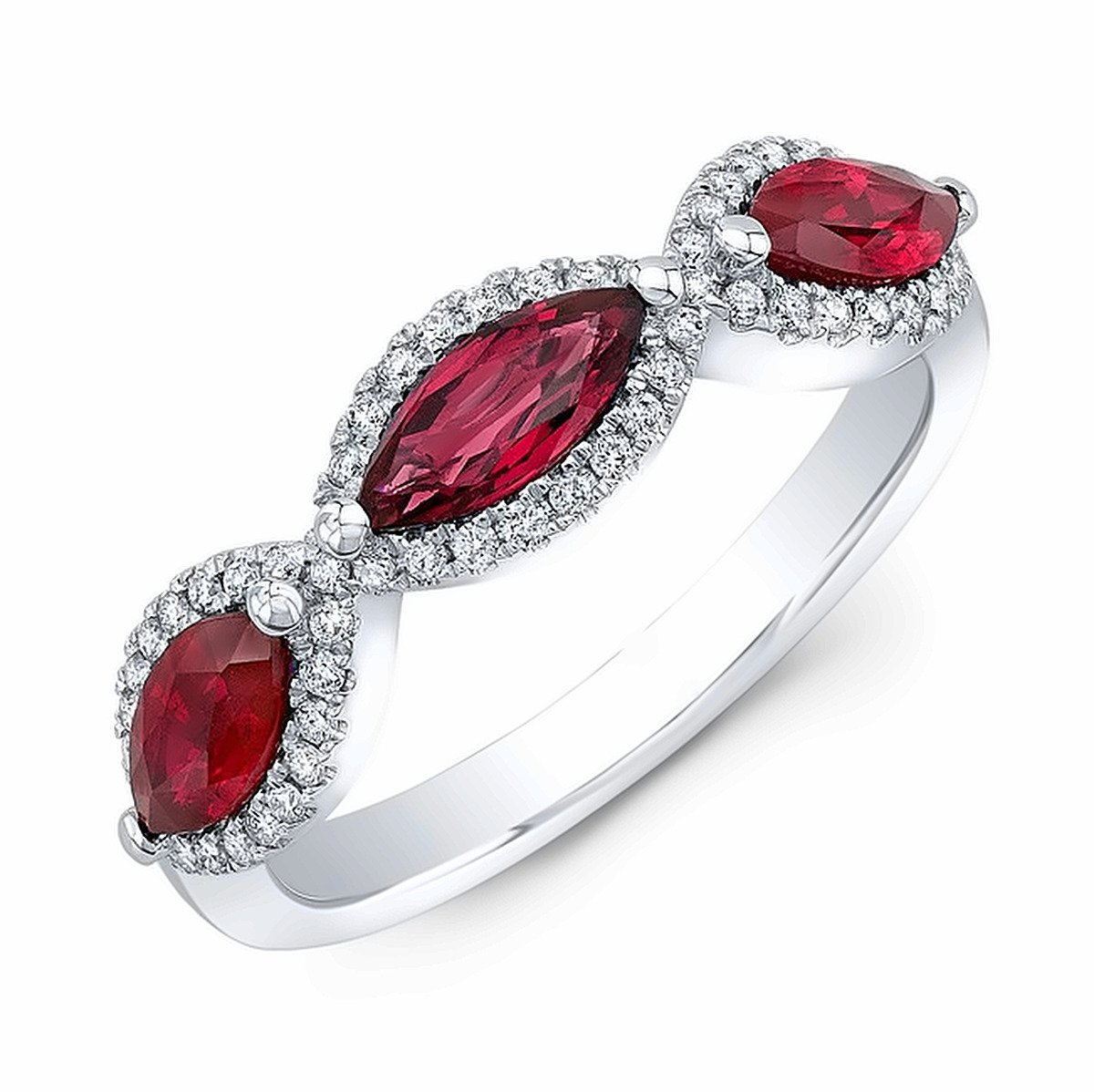
- Ruby rings: the most popular choice, from solitaires to three-stone and halo designs, and a meaningful alternative to a diamond engagement ring.
- Ruby pendants: a single fine ruby on a delicate chain sits beautifully against the skin and draws the eye.
- Ruby earrings: studs for daily wear or drops for occasions, with matched pairs of good colour commanding a premium.
- Ruby wedding bands and eternity rings: rubies claw or channel set, alone or alternating with diamonds, make a rich and durable band.
Whatever the piece, our fine jewellery collection and our bespoke design and repair service let you commission a piece around a stone you love.
Ruby as the July birthstone and anniversary stone
Ruby is the birthstone for July, which makes it a heartfelt gift for anyone born in that month. It is also the traditional gemstone for the fifteenth and fortieth wedding anniversaries, its red long tied to love and devotion. That dual meaning makes ruby jewellery a natural choice for milestone gifts. To explore stones by month, see our guide to birthstones by month, and for wider inspiration read our gemstone jewellery guide for Cayman.
Certification and buying rubies tax-free in Grand Cayman
For any significant ruby, ask for an independent laboratory report. Respected laboratories describe the colour and measurements and, crucially, whether the stone is natural, its treatment status and often its geographic origin. A report protects your purchase and confirms exactly what you own.
The Cayman Islands levy no sales tax and no VAT, so ruby jewellery here is genuinely tax-free. Compared with the United States, the United Kingdom or Europe, fine jewellery can cost meaningfully less, with no duty to reclaim and no paperwork at the till. The table below sets out how the main categories of ruby compare.
| Ruby type | Rarity | Durability | Relative price | Best suited to |
|---|---|---|---|---|
| Natural, unheated | Very rare | Excellent | Highest | Collectors and heirloom pieces |
| Natural, heat-treated | Widely available | Excellent | High | Fine everyday and milestone jewellery |
| Lab-grown | Not rare | Excellent | Low | Maximum colour and size on a budget |
| Glass-filled composite | Not rare | Poor | Very low | Not recommended for fine jewellery |
To understand the savings in full, see our guide to tax-free jewellery shopping, and if you are visiting the island our overview of jewellery stores in George Town will help you plan your trip.
Pairing ruby with diamonds and gold
Ruby's warm red is flattered by the right partners. Diamonds are its classic companion: white diamonds sharpen and brighten a ruby's colour, whether as a halo, side stones or accents in a band, and the contrast of icy white against glowing red is timeless. The choice of metal matters just as much.
- Yellow gold: warm and classic, it echoes and enriches the red.
- Rose gold: soft and romantic, offering a gentle, harmonious contrast.
- White gold or platinum: cool and crisp, making the red appear more vivid.
There is no wrong answer, only the mood you wish to create.
Caring for your ruby jewellery
Ruby is tough, but every gemstone rewards a little care.
- Clean with warm water, mild soap and a soft brush, then rinse and dry.
- Avoid harsh chemicals, and avoid ultrasonic cleaners and heat if a stone is glass-filled.
- Store pieces separately so harder stones do not scratch softer settings.
- Have prongs and settings checked periodically by a gemologist.
For a full routine, read our guide on how to clean and care for fine jewellery. IDC Cayman also provides lifetime after-care, including cleaning, prong inspection and resizing.
Why IDC Cayman
IDC Cayman has been part of the George Town waterfront since 2011, offering fine jewellery and coloured gemstones to residents and visitors alike. Our in-house gemologists select each ruby by eye, disclose every treatment and provide independent certification for important stones, all tax-free with no sales tax or VAT. We also offer GIA-certified diamonds to pair with your ruby, bespoke design, free insured worldwide shipping and lifetime after-care that includes cleaning, prong inspection and resizing. Learn more about us, browse our fine jewellery collection, or contact us to begin. You are welcome to walk in Monday to Saturday, 09:00 to 17:00, at 38 Seafarers Way, with no appointment needed.