
Topaz is one of the most misunderstood gemstones, partly because the name covers such a wide spectrum of colour and value. At one end sit the bright, affordable blues seen in cocktail rings the world over; at the other, the rare and aristocratic imperial topaz that collectors chase for years. Knowing which is which, and what has been done to each, is the heart of buying topaz wisely. This guide walks through the colours, the treatments, and the one quirk of durability that every owner should respect.
In short: most vivid blue topaz is colourless topaz that has been irradiated and heated to a stable blue, while rare imperial topaz glows orange to reddish-pink naturally. Topaz is hard, at 8 on the Mohs scale, but it has a perfect cleavage, so it favours protective settings and gentle cleaning. As a November birthstone it shares the month with citrine, and bought in George Town it is tax-free. Start with our coloured gemstones.
What Topaz Is and Its Colours
The mineral
Topaz is an aluminium fluorosilicate that, in its pure form, is colourless. Trace elements and natural irradiation give rise to its many colours, and because the same mineral can appear in so many guises, the single most useful question to ask of any topaz is simply which colour it is and how that colour came to be. Our coloured gemstone jewellery guide sets topaz alongside its peers for durability and treatment.
A spectrum of colour
Topaz appears in blue across several depths, warm yellow and brown, soft pink, and, most prized of all, the orange to reddish-pink shades known as imperial topaz. Colourless and pale topaz is common and inexpensive, while the strongly coloured natural stones, especially imperial, are far scarcer. Pink topaz, for instance, may be natural or the result of gentle heating, and some brown stones can pale in time, so the back-story of a colour is as much a part of the stone as the hue itself. That spread means topaz can serve as both an affordable statement stone and a serious collector's gem, depending entirely on its colour and origin.
Blue Topaz: Beautiful and Treated
How the blue is made
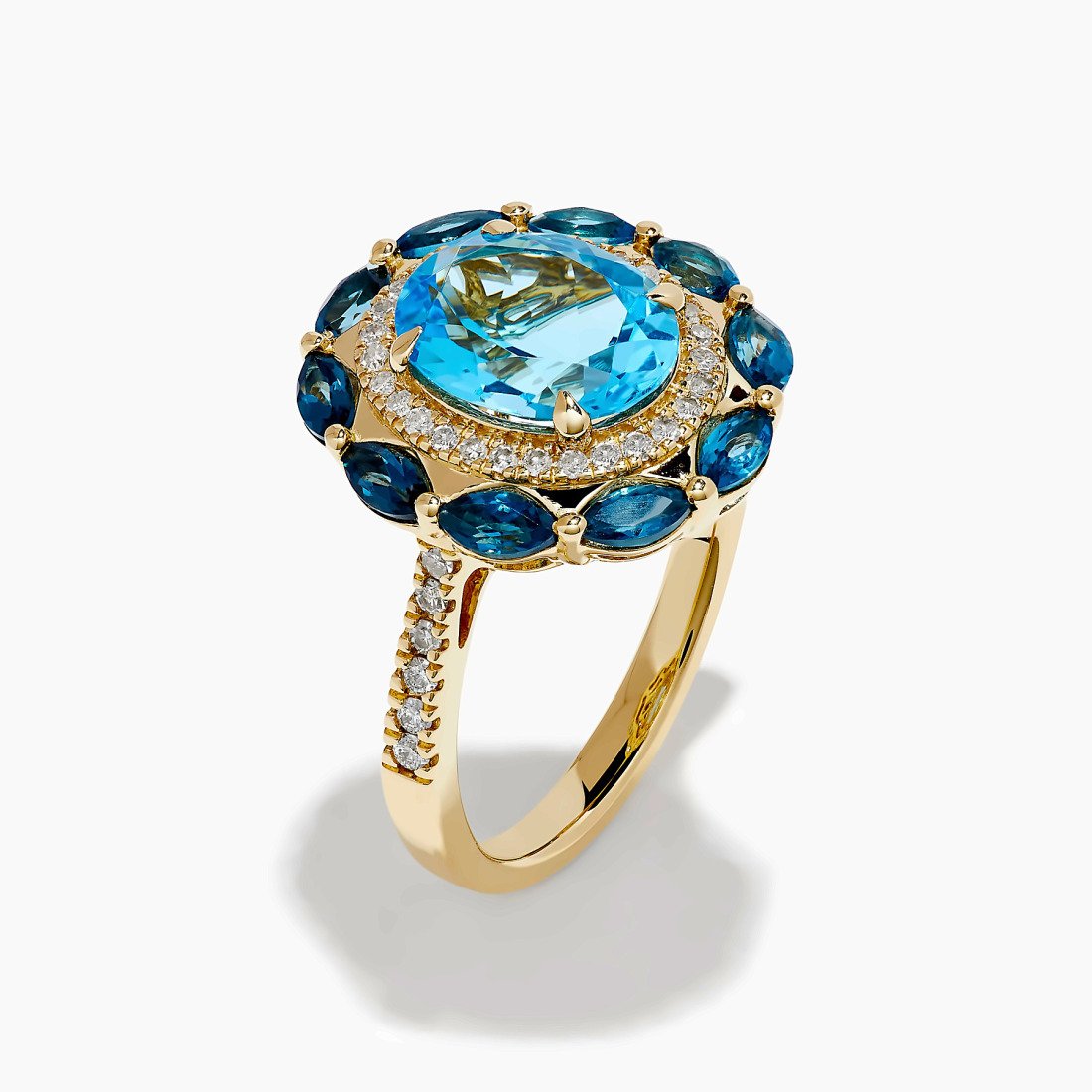
Almost all blue topaz on the market begins as colourless topaz that is irradiated and then heated to produce a stable blue. Naturally blue topaz exists but is very pale and rare, so a vivid blue stone is, with rare exceptions, a treated one. A reputable jeweller is transparent that these colours are created by treatment, and irradiated topaz is held until any residual activity has decayed to safe, regulated levels before sale. The great virtue of blue topaz is value: it is available in large, clean, brilliant stones that make superb statement pieces.
Sky, Swiss and London blue
The trade recognises three broad grades of blue, and it helps to know them by name when you shop:
| Trade grade | Appearance |
|---|---|
| Sky Blue | Light and gentle, the palest of the three |
| Swiss Blue | Bright, vivid, slightly greenish medium blue |
| London Blue | Deep, inky, slightly steely blue |
Imperial Topaz: The Rare Aristocrat
Imperial topaz is the gem that earns topaz its place among the finer coloured stones. Its glowing orange to reddish-pink, sometimes likened to sherry or the colour of a sunset, occurs naturally and is genuinely rare, with the historic source being Ouro Preto in Minas Gerais, Brazil, and antique material once coming from Russia. Some pink topaz is produced by gently heating suitable imperial rough. Because fine imperial topaz is scarce and unmistakably warm in tone, it is treasured by collectors and looks its richest in yellow or rose gold, as explained in our precious metals guide. Across all colours, the value of topaz rests on a few clear points:
- Colour and type, the dominant factor. Rare natural imperial orange-pink leads, followed by saturated blues; pale, washed-out stones are the most common and least valuable.
- Clarity, where faceted topaz is expected to be eye-clean, since the material is readily available in clean sizes.
- Cut, which maximises brilliance and shows the colour evenly; topaz takes a high polish and a precise cut rewards it.
- Carat, as blue topaz is affordable even in large sizes, while large fine imperial topaz is exceptional and prized accordingly.
Topaz at a Glance
The essentials in one view:
| Property | Topaz detail |
|---|---|
| Mineral | Topaz, an aluminium fluorosilicate |
| Mohs hardness | 8, but with perfect basal cleavage |
| Colour range | Colourless, blue, yellow, brown, pink, imperial orange to reddish-pink |
| Main sources | Brazil (imperial, Ouro Preto), Sri Lanka, Nigeria, Namibia |
| Birthstone | November, with citrine; blue topaz marks the fourth anniversary |
| Common treatment | Most blue topaz is irradiated and heated; imperial is natural |
| Care | Warm soapy water and a soft brush; avoid ultrasonic and steam cleaners |
Ask two questions of any topaz: what colour is it, and how did that colour come to be. The honest answer tells you almost everything about its value.
Durability, Cleavage and Care
Hardness versus cleavage
Topaz is hard, at 8 on the Mohs scale, but it has one important weakness: a perfect basal cleavage, meaning a sharp knock in the wrong direction can cause it to split cleanly. Hardness resists scratching, but cleavage demands respect, so topaz is happiest in protective settings such as bezels or halos, and you should remove rings during sport and heavy chores and avoid hard blows. For everyday wear in a ring, a protected setting is well worth choosing; our fine jewellery shows topaz set securely.
The November birthstone
Topaz is a birthstone for November, sharing the month with citrine, while blue topaz is the traditional gift for the fourth wedding anniversary. See where it sits in our birthstones by month guide, and find pairings in our anniversary jewellery gift guide.
Cleaning topaz safely
Because of that cleavage and a sensitivity to sudden temperature change, ultrasonic and steam cleaners are best avoided. Clean instead with warm soapy water and a soft brush, then rinse and pat dry, and keep some brown and treated stones out of prolonged strong sunlight, which can lighten certain colours. Our jewellery care guide sets out the full routine.
Buying Topaz in Grand Cayman
From a generous blue cocktail stone to a rare imperial collector's piece, our GIA-certified gemologists will explain exactly what a topaz is, how its colour was achieved and how to wear it safely. Browse our coloured gemstones and fine jewellery at your leisure. Visit us in George Town, Grand Cayman, where no appointment is needed and every purchase is entirely tax-free, with no sales tax and no VAT. When you are ready, come and find us on the waterfront.